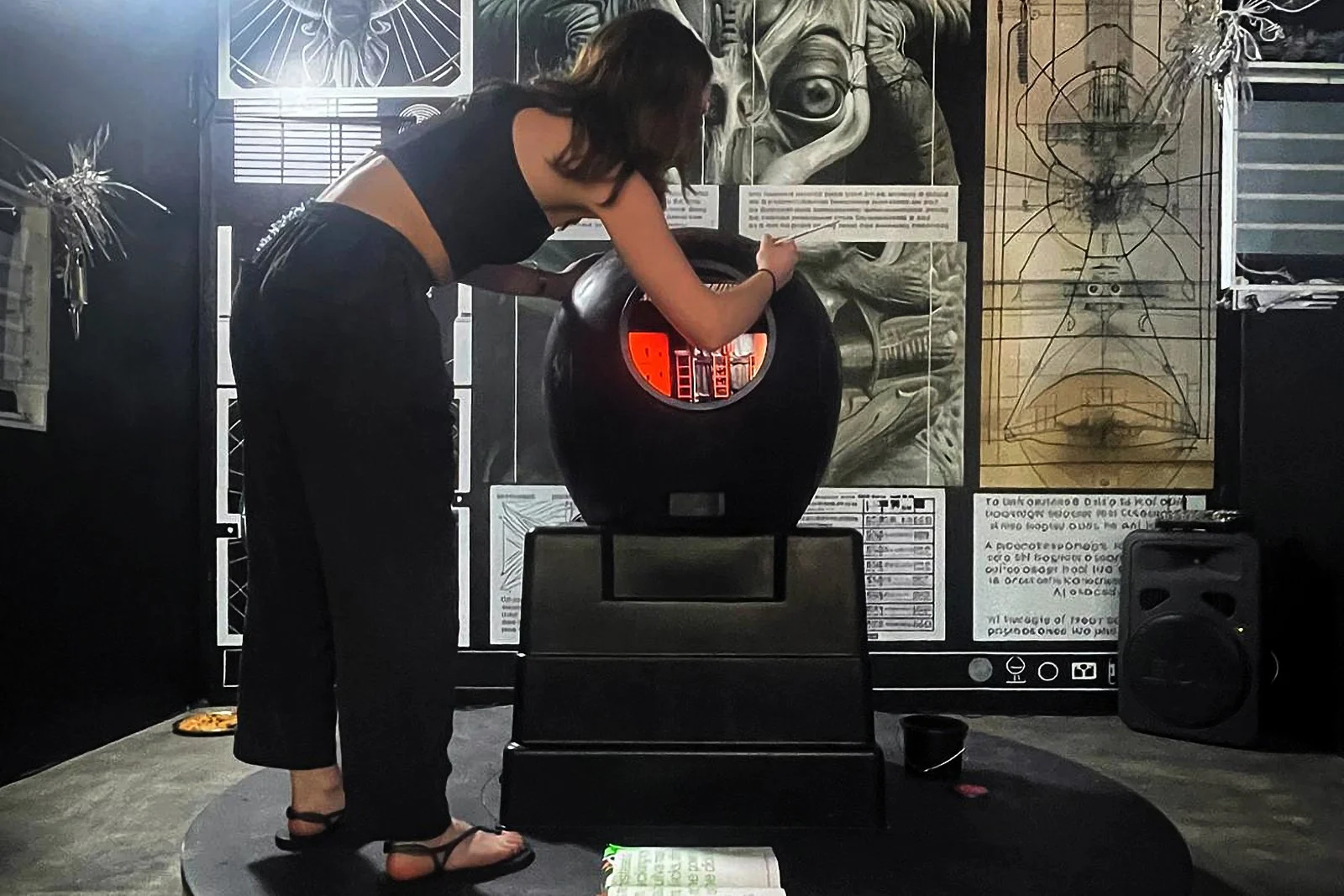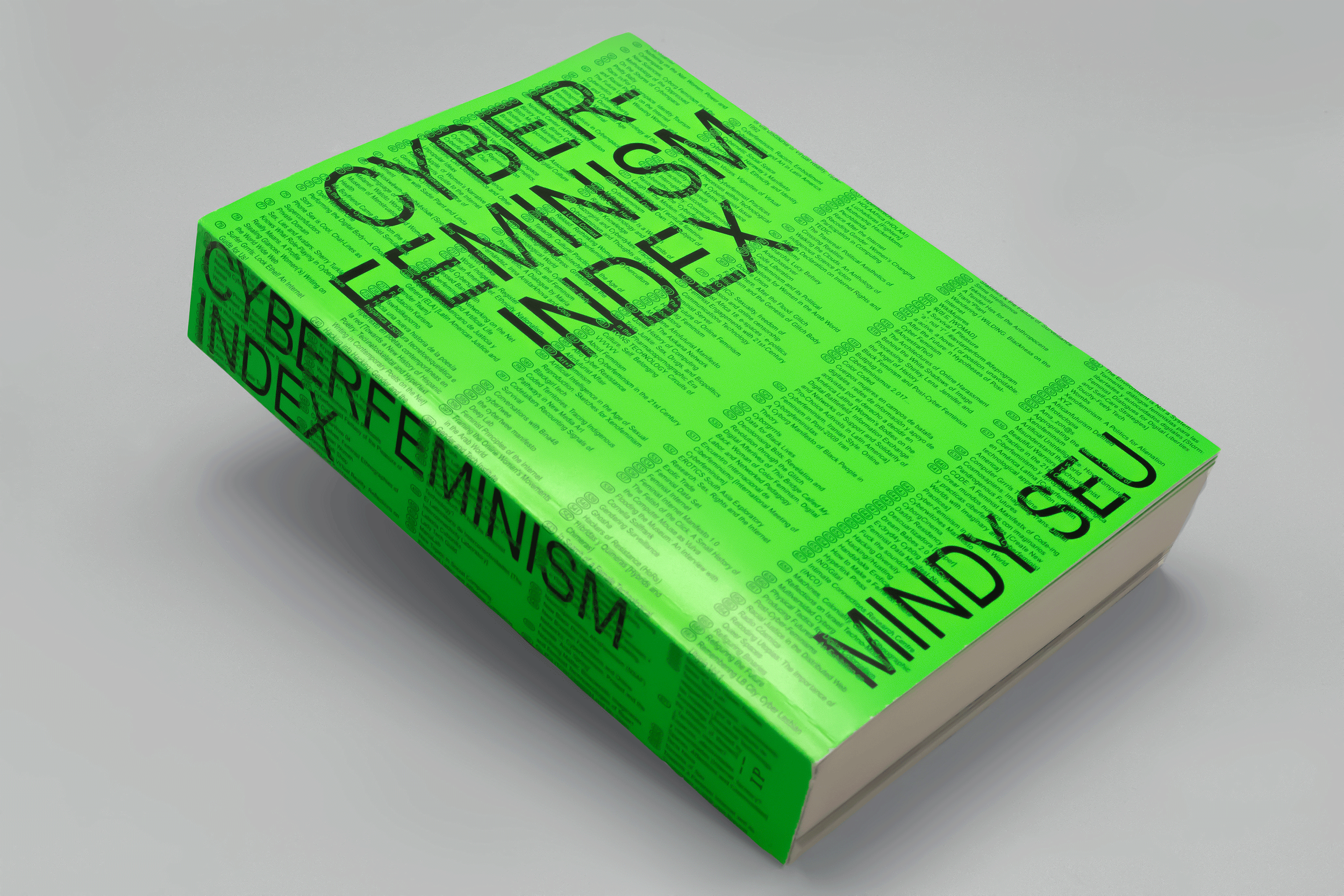
Performed a lecture-performance with meditative writing as part of HYPHA FIXED – Phantom Arena, an Exhibtion and Events program curated by Kiik Amor. Reading from Mindy Seu’s Cyberfeminism Index, I delivered the text in a rhythmic, intentional manner that echoed the cadence of ritual and invocation. As I read, I slowly inscribed selected lines onto a sculptural form, allowing the act of writing to become a contemplative extension of the voice. The performance explored cyberfeminism as an embodied and reflective practice, merging theory, gesture, and presence.
Book Featured in This Reading Performance
Cyberfeminism Index
Edited by Mindy Seu
Cyberfeminism Index is a major archival project that gathers more than three decades of cyberfeminist thought, rebellion, art, and technological critique. Edited by designer and researcher Mindy Seu, the book brings together manifestos, artworks, networks, code experiments, and radical texts from 1990 to today.
It traces the lineage of feminist interventions in digital culture, highlighting voices that challenge patriarchal infrastructures, imagine alternative futures, and hack technological systems from the margins.
Explore the project online:
https://cyberfeminismindex.com
Readings from the Cyberfeminism Index
*
Readings from the Cyberfeminism Index *
“Data is a double-edged sword. In a very real sense, data has been used as a weapon by those in power to consolidate their control—over places and things, as well as people. Indeed, a central goal of this book is to show how governments and corporations have long employed data and statistics as management techniques to preserve an unequal status quo. (419) Working with data from a feminist perspective requires knowing and acknowledging this history. […] Data is part of the problem, to be sure. But they are also part of the solution. Another central goal of this book is to show how the power of data can be wielded back. […] Our claim, once again, is that data feminism is for everyone. It’s for people of all genders. It’s by people of all genders. And most importantly: it’s about much more than gender. Data feminism is about power, about who has it and who doesn’t, and about how those differentials of power can be challenged and changed using data. We invite you, the readers of this book, to join us on this journey toward justice and toward remaking our data-driven world.”
“We are the modern cunt positive anti reason unbounded unleashed unforgiving we see art with our cunt we make art with our cunt we believe in jouissance madness holiness and poetry we are the virus (35) of the new world disorder rupturing the symbolic from within saboteurs of big daddy mainframe the clitoris is a direct line to the matrix the VNS MATRIX terminators of the moral codes mercenaries of slime (526) go down on the altar of abjection probing the visceral temple we speak in tongues infiltrating disrupting disseminating corrupting the discourse we are the future cunt”
“Important as these concerns might be, in public discourse they continue to be marked mostly by their absence. With safety and security frequently highlighted as surveillance’s goals, one reason for this void seems to be that the harms of surveillance in the digital age continue to remain too abstract for many people. […] “If you’ve got nothing to hide, you’ve got nothing to fear,” they continue to believe. And that is that. If you really have nothing to hide, that speaks rather poorly about the quality of your inner life—and I am not arguing this merely to be provocative. Experiencing doubt, uncertainty and shame is integral to every person’s growth as a human being; it is what makes us human. […] But what is perhaps even more important to highlight is that such arguments also hide from view this: being comfortable with revealing things about yourself often requires privilege. If your own identity and background fits closely within dominant norms—say if you are upper middle class, Hindu upper caste, male and heterosexual in India—you stand far less to lose by revealing details about who you are than if you are a poor, dalit, lesbian woman.”
— ‘Data Feminism’ 2020, Catherine D’Ignazio and Lauren F. Klein (Cambridge, MA: MIT Press, 2020); excerpt pp. 14–19
“Smoothness implies a seductive tactile quality that expresses one of the characteristics of cyborg envy: In the case of the computer, a desire literally to enter into such a discourse, to penetrate the smooth and relatively affectless surface of the electronic screen and enter the deep, complex, and tactile (individual) cybernetic space or (consensual) cyberspace within and beyond. Penetrating the screen (633) involves a state change from the physical, biological space of the embodied viewer to the symbolic, metaphorical “consensual hallucination” of cyberspace; a space that is a locus of intense desire for refigured embodiment. […] Programming itself involves constant creation, interpretation, and reinterpretation of languages. […] Penetration translates into envelopment.
In other words, to enter cyberspace is to physically put on cyberspace. To become the cyborg, to put on the seductive and dangerous cybernetic space like a garment, is to put on the female. Thus cyberspace both disembodies, in Sobchack’s terms, but also reembodies in the polychrome, hypersurfaced cyborg character of the console cowboy. (88) As the charged, multigendered, hallucinatory space collapses onto the personal physicality of the console cowboy, the intense tactility associated with such a reconceived and refigured body constitutes the seductive quality of what one might call the cybernetic act..”
— 1991, ‘Will the Real Body Please Stand Up? Boundary Stories about Virtual Cultures’ Allucquère Rosanne Stone
“Whenever we try to envision a world without war, without violence, without prisons, without capitalism, we are engaging in speculative fiction. All organizing is science fiction. Organizers and activists dedicate their lives to creating and envisioning another world, or many other worlds. […] In the years we have been working on this book, many folks have asked us what science fiction could possibly have to do with social justice organizing. And every time, we have responded, “Everything. Everything.” We want organizers and movement builders to be able to climb the vast space of possibility, to be birthing visionary stories. Using their everyday realities and experiences of changing the world, they can form the foundation for the fantastic, and we hope, build a future where the fantastic liberates the mundane.”
“The Distributed Web of Care seeks to shift the center of tech culture from corporations to a diverse community of technologists, artists, engineers, and scholars, holding identities across races, genders, privilege, and abilities. If the “new internet” is developed by people of color, women, queer folk, and disabled people, we can imagine new protocols and networks, untethered by the constraints which have led to these voices to remain excluded. (593) To bring equality to access and equity to ownership of technology, we need to create new narratives of the internet, tools for learning and empowerment, and systems of interdependence among communities.”
— 2019 ‘Racial Justice in the Distributed Web’ Taeyoon Choi
— ‘Octavia’s Brood: Science Fiction Stories from Social Justice Movements’ 2015, adrienne maree brown and Walidah Imarisha, eds. (Chico, CA: AK Press, 2015); excerpt from Walidah Imarisha, introduction to brown and Imarisha, Octavia’s Brood, p. 1
“Can we exploit the fact that our techno-social systems suck? Or is the future already prescribed by the obsessive intrusion of social media platforms, machine recognition bias, and the AI arms race to come? Data is no longer just captured; it is used to predict a particular slice of the future, to move beyond the 180 degree limit of human linear space-time. Social intelligence is now energy intelligence. Everyone is a data farm. Machine learning systems consume vast amounts of data in order to learn the decisional arc of human-mindsteps. But are we building data walls that make intel-silos? Are we building AI assistant gender-tyrants? Are recognition systems making us into boring products for a shelf? What can we do with the empty silos of this data wasteland?”
— 2018, ‘#d8e0ea: post-cyberfeminist datum’ Yvette Granata
“We are corporeal, biological, incarnate entities, but also and simultaneously: relational and informational beings. We are entities with digital extensions. We live in a physical, technical and digital world. Let’s be hybrid entities living in an hybrid world. Let’s take care of our bodies-hub-server. (683) Our contemporary everyday technical equipment takes part to our ritual forms. (270) Let’s perform technophile rituals. Let’s make the gestures. Let’s say the words. Let’s manipulate the objects. Let’s summon archetypal survivals. Let’s call for the emergence of egregore. Let’s seek for upsurge, Let's seek for a fleeting energetic symbiosis. Let’s practice this art of changing consciousness at will. Let’s be cyberwitches.”
— 2019, ‘Cyberwitches Manifesto’ Lucile Olympe Haute
— 1991, ‘The Cyberfeminist Manifesto for the 21st Century’ VNS Matrix
“Hey, you, staring at the flickering, bleeding screen. We see you, right now, through the cameras on the ground, above the clouds, and within your very hands. Luckily, we’re not the fbi-dot-gov. We are HoRs: sex workers, refugees, immigrants, Witches, Shamans, Sisters, Queer Femmes of color. Looking at last month’s credit card statement, you spent 24.99 for the gym and 55.42 at GNC. Why don’t you consider bulking up your cybersecurity? Don’t worry. We’re on your side. The Hors will help you reclaim your life and reprogram the 1’s and 0’s that build our world. Non-hegemonic, Non-normative, Non-conforming Hacktivists. […] Our bodies are networked. Their servers, our battleground. We will overflow their system gates. […] To defend against corporate fascism, we must break their tools and craft our own. To hack is to create, design, and resist. What we do is self-defense, self-determination. We will survive suppression! We must reroute the flow of information and resources to the people. We must scream until we are no longer ignored. We must kick until their walls fall down. You have power. Let’s take matters into our own hands. Hack because we refuse to stay in the dark.”
— 2017 ‘Hackers of Resistance’ (HoRs)
— 2017 ‘Gendering Surveillance’ Dr. Anja Kovacs